
Will AI Lead to Massive Technological Unemployment?
Published:
Winter is coming.
In April 2025, Shopify CEO Tobi Lutke told employees that before asking for more headcount, teams must first show why AI cannot do the job. That sentence may capture the future of white-collar work more clearly than any abstract debate: AI is no longer just a tool to help workers. It is becoming a reason not to hire them in the first place. Every industrial revolution has disrupted jobs, but it has always created new ones. The rise of AI raises a more unsettling question: what if this time it does not?
The Luddite Fallacy and Compensation Effects
During the 20th century and the first decade of the 21st century, the dominant view among economists was that long-term technological unemployment was a fallacy, often described as the Luddite fallacy. People who use the term typically expect that technological progress will have no lasting negative effect on employment and will eventually raise wages, because compensation effects increase the overall wealth of society.
Compensation effects typically include:
- New machines. Building and maintaining new equipment creates additional labor demand.
- New investments. Cost savings and higher profits can stimulate investment in new activities.
- Changes in wages. If unemployment temporarily lowers wages, firms may rehire workers at lower cost; if productivity rises, higher wages can also increase spending and support job creation.
- Lower prices. Lower prices can increase demand and therefore employment, while also offsetting wage pressure by raising purchasing power.
- New products. Innovation can directly create entirely new categories of jobs.
Why AI May Be Different
However, I believe that the long-term impact of AI on technical and creative industries cannot be predicted by this compensation mechanism, because the benefits of AI automation are not equally distributed.
First, the suppliers of AI technology are highly concentrated. Previous industrial revolutions created diverse companies across manufacturing, services, and information industries, generating large numbers of new jobs in the process. In the AI industry, however, only a handful of companies can develop frontier foundation models, such as OpenAI, Google, Alibaba, and DeepSeek. Only a few companies, such as NVIDIA, Google, and Huawei, can produce practical computing hardware that runs those models. These companies employ a relatively small number of highly paid core researchers, while much of the value in downstream AI applications is concentrated in these upstream providers. This creates a highly monopolistic market, and it is unlikely that many new entrants will emerge in the foreseeable future. As a result, while AI may replace entry-level software engineers, junior artists, and content creators, it may not create an equivalent number of new jobs.
Second, productivity gains from AI in technical and creative industries may not lead to enough additional demand to compensate for job losses. The IT and entertainment industries are part of an attention economy, competing for people’s limited time. A person only has so many hours in a day. Even if the number of apps or media products increases a hundredfold, people cannot consume proportionally more. Therefore, only a small group of top performers may ultimately benefit from this productivity boom.
Finally, will AI increase the earnings of workers who know how to use it and thereby improve their productivity? I think this is also uncertain. Traditionally, individuals improve their skills and accumulate experience over time, which leads to higher wages. However, as AI advances, it may quickly reach or even surpass the level of mid-level human experts in many fields. At that point, the value of accumulated experience for ordinary workers may diminish significantly. For example, an artist who spends a lifetime mastering their craft may still produce work that is judged inferior to images generated by AI tools in seconds. This possibility is deeply concerning.
Possible Responses
What responses are available if this risk turns out to be real?
What Can Society Do?
Ban technology. Historically, innovations were sometimes blocked because of concerns about their impact on employment. A famous example is William Lee’s knitting machine, which Queen Elizabeth I reportedly refused to patent on the grounds that it might cause unemployment among textile workers. In practice, however, this option is rarely treated as a serious solution in advanced economies today.
Reduce working hours. A practical method is to reduce working hours. In 1870, the average American worker clocked about 75 hours per week. Just prior to World War II, working hours had fallen to about 42 per week, and the decline was similar in other advanced economies. According to Wassily Leontief, this could be interpreted as a voluntary increase in technological unemployment. The difficulty is that employers may lack the incentive to reduce working hours on their own.
Universal basic income. In recent years, the idea of universal basic income (UBI) has become increasingly popular. Under this proposal, all members of a population regularly receive a minimum income through an unconditional transfer. Supporters argue that UBI could help people share in the wealth generated by automation. Critics argue that a meaningful UBI would be extremely costly and may not be financially sustainable. They also worry that unconditional payments could weaken incentives to work, push up labor or housing costs, and be unfair because everyone receives the same amount regardless of need.
Broaden the ownership of technological assets. Another proposal is to broaden the ownership of AI systems, robots, and other productive technological assets. The basic idea is straightforward: if AI-driven automation increases the returns to capital while reducing the share of income going to labor, then more people should be allowed to own a stake in that capital rather than relying only on wages. Recent policy discussions have therefore considered mechanisms such as state ownership, public or sovereign wealth funds, universal basic capital, and profit-sharing arrangements so that ordinary citizens can share in the gains generated by AI.
Supporters argue that this approach would allow technological progress to raise household wealth more broadly, not just corporate profits. Critics note that such proposals are difficult to implement in practice: AI-related assets are hard to value, ownership may become concentrated again, and these policies could weaken incentives for private investment and innovation. Still, among long-term responses to AI-driven displacement, this idea is attractive because it tries not merely to compensate the losers after the fact, but to reshape who benefits from automation in the first place.
What Can Individuals Do?
Now, as individuals, what can we do to adapt to the AI automation wave?
Choose the right career. Not all occupations face the same degree of AI replacement risk. According to Anthropic’s labor market study, occupations such as Computer & Math and Office & Admin are much easier to automate with AI, while occupations like cooks, motorcycle mechanics, and lifeguards are much harder to automate.
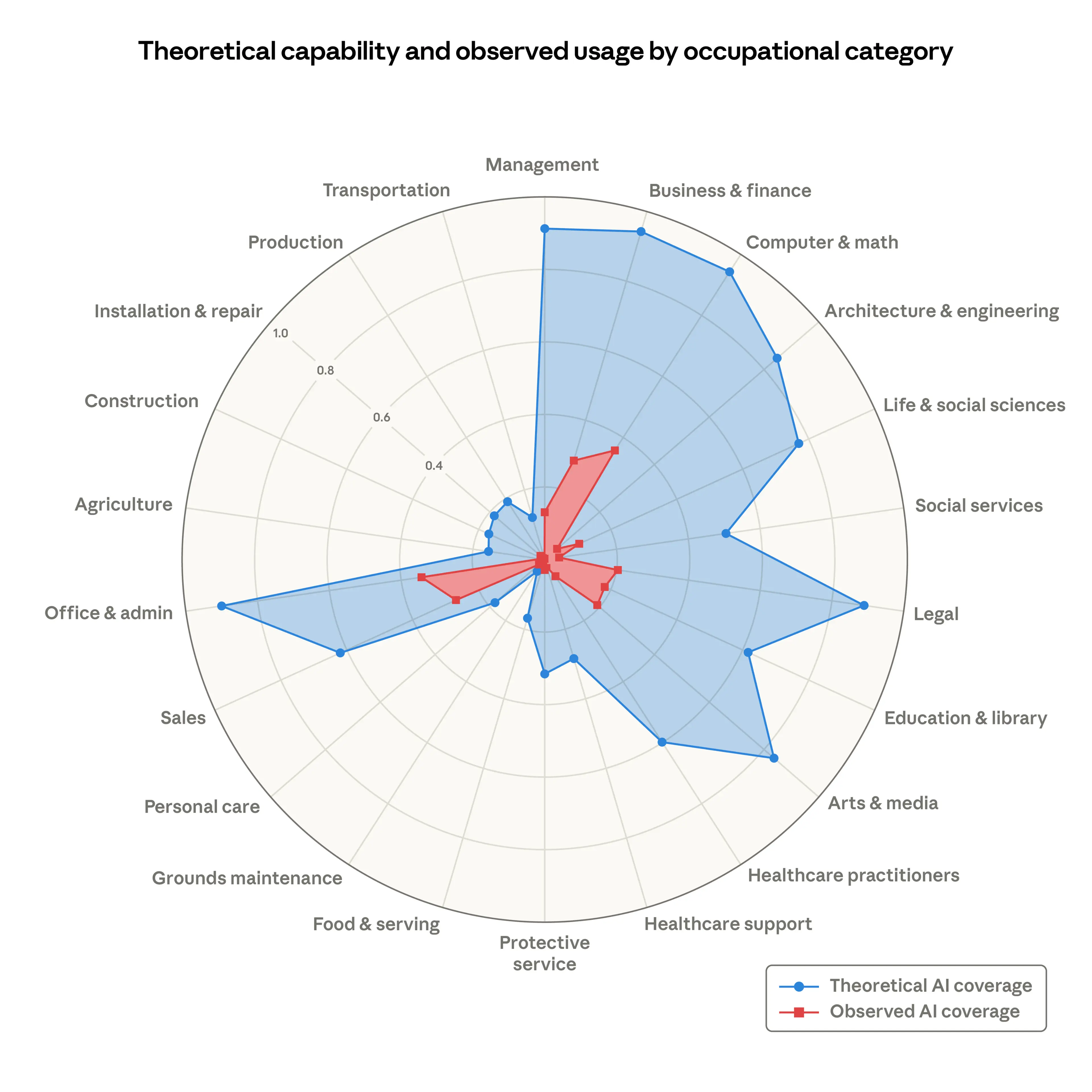
Occupations vary significantly in their exposure to AI, with many white-collar knowledge tasks appearing more automatable than physical jobs. A fact that may seem counterintuitive to many people is that high-paying, highly educated white-collar jobs may, in some cases, be more vulnerable to AI than certain physical, blue-collar occupations. This reflects what is often referred to as Moravec’s paradox: tasks that are easy for humans, such as perception, movement, and physical interaction with the real world, are often difficult for machines, while tasks that are cognitively demanding for humans, such as writing, coding, or symbolic reasoning, can be easier for AI.
As a result, AI systems can already write code, generate reports, draft marketing copy, and even assist in decision-making at a high level. However, they still struggle with seemingly simple physical tasks, such as taking clothes out of a washing machine and folding them neatly, repairing a motorcycle, or working as a cook on a cargo ship.
For ordinary workers, this suggests an important shift: the traditional assumption that more education and higher cognitive skill automatically lead to greater job security may no longer hold. In an AI-driven economy, roles that require physical interaction with the real world, adaptability, and embodied skills may prove more resilient than many knowledge-based jobs.
Learn to work with AI, not compete against it. For most individuals, the most realistic strategy is not to outperform AI, but to collaborate with it effectively. AI excels at speed, scale, and pattern recognition, while humans retain advantages in judgment, long-horizon context understanding, and responsibility. Workers who can integrate AI into their workflows, using it to automate routine tasks, enhance productivity, and extend their capabilities, are more likely to remain competitive.
In this sense, AI literacy may become as fundamental as computer literacy once was. The key is not just knowing how to use AI tools, but understanding their limitations, verifying their outputs, and incorporating them into real-world problem-solving.
Move toward tasks that require accountability and communication. Another important strategy is to move toward roles that require building relationships, communication, and trust with other people. Many jobs are not just about producing outputs, but about coordinating with others, understanding implicit needs, and being accountable for decisions.
AI can generate answers, write reports, and even assist in decision-making, but it does not truly participate in social relationships. It cannot build long-term trust, navigate complex human dynamics, or take responsibility in a meaningful way when outcomes matter.
For individuals, this suggests that tasks involving collaboration, negotiation, client interaction, and team leadership may be more resilient. In these contexts, value is created not only by what you produce, but also by how you communicate, align incentives, and maintain trust over time.
Stay positive. Some optimists argue that the advancement of AI could, for the first time in history, make it possible to liberate humans from work driven purely by necessity. If AI and automation can take over most productive labor, society may eventually reach a point where material scarcity is significantly reduced. In such a world, people would no longer need to work simply to survive. Instead, they could spend more time pursuing meaning, creativity, aesthetic expression, and personal growth.
From this perspective, AI is not just a source of disruption, but a potential pathway to a fundamentally different social and economic system in which the link between labor and survival is weakened. Some even see this as a step toward a post-scarcity society, where individuals are freer to develop their abilities beyond economic constraints.
Of course, whether this vision becomes reality depends not only on technological progress, but also on how its benefits are distributed. Still, maintaining a degree of optimism may be useful.